Selling online without a registered business
What a seller in Ghana can use with a Ghana Card and a MoMo wallet in their own name, where registration comes in, and where to check the rules.
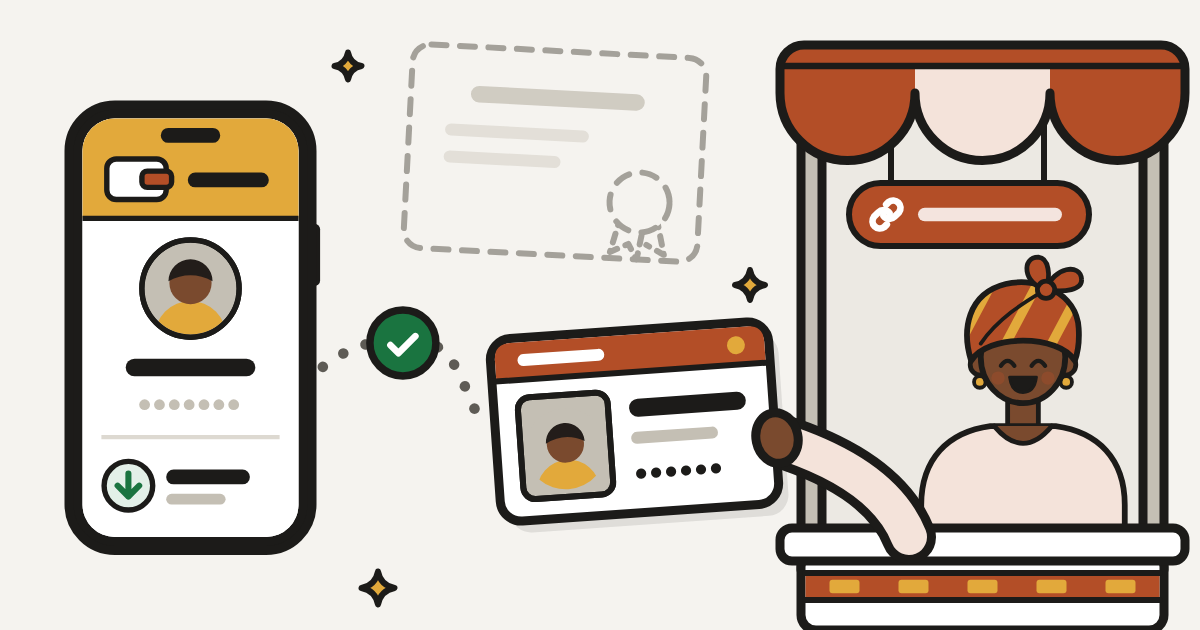
Many of the tools a social seller needs ask only for a Ghana Card and a MoMo wallet in your own name: a personal MoMo wallet, the WhatsApp Business app, a Paystack Starter Business account, and some store-link services, MeKiosk among them. A registration certificate comes in when you want more from some of them, such as collecting more than Paystack’s GH¢30,000 limit for unregistered businesses.
This guide covers what each tool asks for. It isn’t legal or tax advice. Whether and when to register a business is a question for the Office of the Registrar of Companies (ORC), the Ghana Revenue Authority (GRA) or a professional you trust.
Your Ghana Card number is your tax number
Several sign-up forms ask for a tax identification number (TIN). Ghana’s note on tax numbers, published by the OECD, says that from 1 April 2021 the Ghana Card PIN “became the TIN for individuals who are eligible for the Ghanacard”. MyJoyOnline reported the change on the day: “the Ghana Card replaces the Taxpayer Identification Number of individuals” (MyJoyOnline).
So when a form for an individual asks for your TIN, it’s asking for the PIN on your Ghana Card. Having a TIN doesn’t tell you what tax you owe. For that, the GRA’s website is gra.gov.gh.
What you can use with a Ghana Card and your own wallet
A personal MoMo wallet
It’s the most common way Ghanaian firms take digital payments, even big ones. In ReFinD’s announcement of its census of digital payments by firms, launched in April 2025, Prof. Annan said: “Personal mobile money accounts remain the most widely used digital payment option, even among larger firms.”
Watch your wallet’s KYC level. Under limits that took effect on 1 March 2024, a minimum KYC wallet can handle GH¢3,000 a day, hold GH¢5,000 and handle GH¢10,000 a month. A medium KYC wallet can handle GH¢15,000 a day and hold GH¢40,000, and an enhanced one GH¢25,000 a day and GH¢75,000, with no monthly limit on either (Graphic Online). If sales are growing, ask your network what a higher level needs before you hit a limit in the middle of a busy week.
Some buyers will hesitate at a personal number. The Cyber Security Authority has told shoppers: “Ensure mobile money transactions are made to official business accounts” (Graphic Online). Tell buyers the name on your wallet before they pay, and keep using the same wallet so the name never changes. Our comparison of MoMo numbers, payment links and store links weighs this up in more detail.
The WhatsApp Business app
WhatsApp says the app is free to download from the Android and iPhone app stores. To get started, you verify your phone number, then “fill in your business name, business category, and upload a logo or profile image”.
Its features suit a seller working from one phone. The catalogue lets you “Showcase your products and services in a mobile storefront and group similar items into collections”. Quick replies let you answer common questions “in just a few taps”, and away messages tell buyers when you’ll be back.
A Paystack Starter Business
Paystack’s Starter Business “is designed for merchants who are yet to register their businesses with the regulators in their countries” (Paystack). In Ghana it asks for three things (Paystack):
- “A government-issued form of identification”, which can be a passport, national ID card, driver’s licence or voter’s card.
- A “Tax identification number”. See the section above on your Ghana Card PIN.
- A “Personal bank account number or personal mobile money number”.
“All the information you provide must belong to the same person”, so the names must match.
The limit is the catch. A Starter Business in Ghana can collect GH¢30,000. After that, “payments for your business will be temporarily disabled” until you upgrade to a Registered Business. Starter accounts also can’t use Paystack’s Transfers.
A store link
Store-link services set their own rules, so check what each one asks for before you sign up. MeKiosk’s requirements are at the end of this guide.
Where registration comes in
To lift Paystack’s limit, you upgrade to a Registered Business. For a sole proprietorship, Paystack asks for a “Certificate of Registration”, and for a company limited by shares, a “Certificate of Incorporation”, “Form 3” and a “Tax Identification Number” (Paystack).
Merchant accounts from the mobile networks have their own requirements. Ask your network what it needs before you apply.
If you decide to register
Pulse Ghana’s 2026 guide to registering a business calls a sole proprietorship “the simplest and most common structure, ideal for individual entrepreneurs”. It also notes that the owner has unlimited liability for the business. Its steps, in short:
- Check the name. “Check if your desired business name is available using the RGD Name Search function online or at an ORC office”, then reserve it.
- Get your TIN. The guide says “All business principals must obtain a TIN from the Ghana Revenue Authority.” MyJoyOnline’s 2021 report said that for “registering of businesses, the Ghana card PIN should be quoted” (MyJoyOnline).
- Fill in the forms. “Sole proprietorships use Form A”.
- Send the documents. The guide lists the completed forms, identification such as a Ghana Card, TINs and proof of your business address. You can apply online through the e-Registrar portal or in person.
- Pay the fees. There’s a registration fee and a renewal every year. Check the current amounts with the ORC before you pay.
Registering a business name and paying tax are separate questions. The GRA handles the second.
Look like a business either way
Registered or not, you can do these today:
- One name on every page, and the same name in your bio, your catalogue and your kiosk.
- One number that answers, and a wallet name you tell buyers before they pay.
- A written order confirmation and a returns and refund policy buyers can read before paying.
- A record of every order, matched against your MoMo statement.
Our guide to showing buyers you’re a real vendor goes through these one by one.
How MeKiosk handles this
MeKiosk is open to sellers in Ghana. To take payments, you check your Ghana Card with a selfie, and your MoMo wallet must be in your own name, matched against the card. You don’t need a registered business, but you must be 18 or over.
You get one link for everything you sell, like ama-closet.mekiosk.shop, and it never changes. Buyers pick what they want, give their name and number, and approve a MoMo prompt on their own phone: MTN MoMo, Telecel Cash or AirtelTigo Money. They need no app and no account. If the prompt doesn’t come, they can pay on Paystack’s own page instead.
An order turns Paid only when Paystack confirms the money, never from a screenshot or a text, and you get an alert with the buyer’s name and the order code. Your share goes to your own MoMo wallet the next working day, and weekend sales arrive on Monday.
It’s free to open, with no monthly bill. MeKiosk takes 1% of each paid order (VAT included). The buyer pays Paystack’s Mobile Money fee, 1.95%, on top of the price and sees it before paying. MeKiosk is setting up 30 founding kiosks with their sellers, one by one, and founding kiosks pay no MeKiosk fee for their first 3 months. Once you’ve opened a kiosk, ask for a place in the app under Account → Help on WhatsApp.
The iPhone app is on the App Store. On Android, ask for early access and we’ll set you up on WhatsApp. To open your own kiosk, get the app.
Sources
- Information on Tax Identification Numbers: Ghana · OECD (Ghana's own note), Undated, written in 2021; read 22 Nov 2026
- Ghana Card replaces TIN from today · MyJoyOnline, 1 Apr 2021
- ReFinD marks significant milestone with Ghana's first-ever census on digital payment adoption by firms · ReFinD, ISSER, 8 Apr 2025
- See the new Momo balance & transaction limits effective March 1 · Graphic Online, 28 Feb 2024
- Cyber fraud surges to GH₵4.4million in first quarter of 2025 · Graphic Online, 1 Apr 2025
- Get started with the WhatsApp Business app · WhatsApp Business, Undated, read 22 Nov 2026
- Business App Features · WhatsApp Business, Undated, read 22 Nov 2026
- Compliance requirements for Ghana · Paystack Help Centre, Undated, read 22 Nov 2026
- Paystack business types · Paystack Help Centre, Undated, read 22 Nov 2026
- How to Register Your Business in Ghana: Complete Guide for 2026 · Pulse Ghana, 3 Feb 2026