MoMo number, payment link or store link?
A fair look at three ways Ghanaian social sellers take MoMo: what each costs, how you know who paid, what buyers trust, and the work to set up.
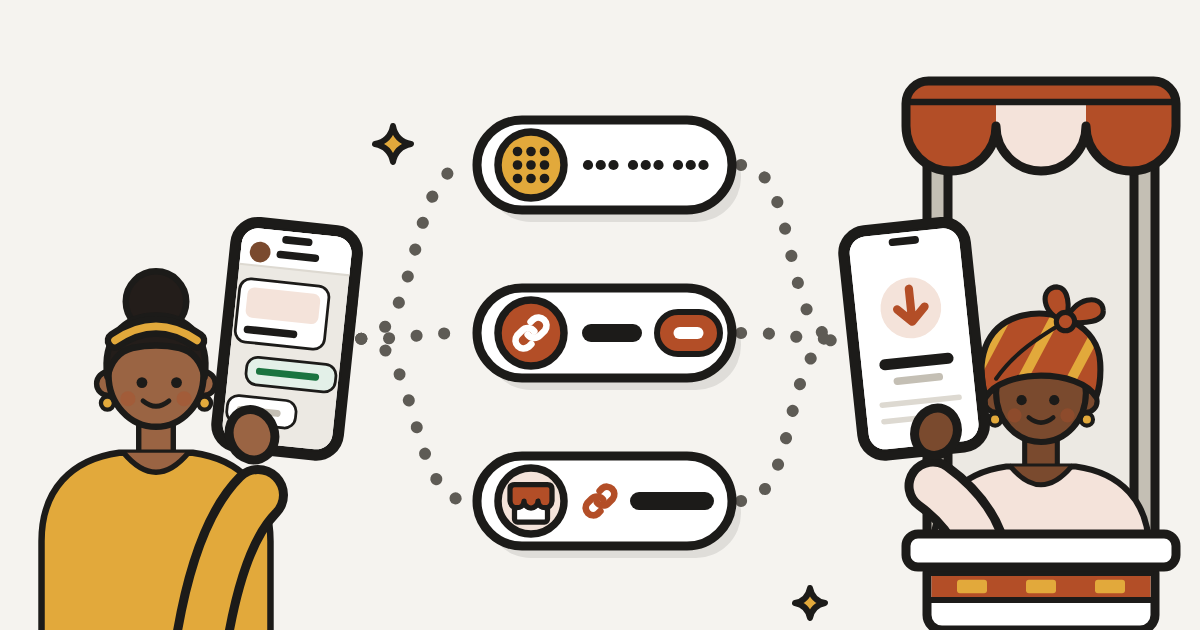
Most social sellers in Ghana take payment in one of three ways: a personal MoMo number sent in the chat, a payment link such as a Paystack Payment Page, or a store link where buyers pick items and pay at a checkout. A personal number costs nothing to start and suits a few orders from people who already trust you. A payment link suits fixed-price items and custom orders agreed in the chat, and a store link suits sellers with many products, buyers they’ve never met and stock that runs out.
WhatsApp’s own in-chat payments aren’t offered in Ghana (Arkesel), so the money always moves outside the chat. Below, each option is weighed on the same five points.
A personal MoMo number is free and familiar, and you do the checking
The lead researcher on a study of Ghanaian firms by ISSER and the Ghana Statistical Service said that “personal mobile money accounts remain the most widely used digital payment option, even among larger firms” (ReFinD). Buyers know how to send to a number.
Cost. There’s nothing to sign up for and no payment company taking a share. The e-levy ended on 2 April 2025 (3News), but your network’s own transfer and cash-out fees still apply, so check its menu for today’s rates. Who pays them is a sore point: one business owner told MyJoyOnline that “some customers don’t add the charges”, which cuts what’s left at cash-out (MyJoyOnline).
Knowing who paid. You match each SMS alert to a chat, often against a screenshot the buyer sends. A MyJoyOnline column describes a seller “manually matching MoMo alerts against customer screenshots” as “a reconciliation problem worth solving” (MyJoyOnline). Messages and screenshots can be faked. Businesses report “fake payment alerts” and “reversal fraud”, where customers “make payments, collect goods and later reverse the transaction” (MyJoyOnline).
What the buyer sees. A wallet in your own name. The Cyber Security Authority warns that scam shops take payment into MoMo wallets that “usually do not bear the names of the supposed shops”, and tells buyers to pay only after they receive and inspect the goods (CSA). It has also told buyers to make sure MoMo payments go “to official business accounts” (Graphic). Honest sellers meet buyers who have read those warnings.
Stock and orders. Only you keep track. If two buyers pay for your last pair of shoes, you find out when you check.
Set-up and limits. Nothing to set up. Under limits that took effect on 1 March 2024, a basic (minimum KYC) wallet can handle GH¢3,000 a day, hold GH¢5,000 and handle GH¢10,000 a month; higher KYC levels have higher limits (Graphic).
A payment link is quick to set up, and Paystack confirms the money
A payment link opens a checkout page run by a payment company. Paystack’s version is the Payment Page. You make one in your Paystack dashboard and share its link, such as paystack.com/pay/BellaShoes, “via email, WhatsApp, Twitter or any medium you choose” (Paystack).
Cost. Paystack charges 1.95% on local payments in Ghana, MoMo included, and it comes out of what you collect unless you raise your prices or ask Paystack’s support to add it to the buyer’s total (Paystack). Say you sell a bag for GH¢200: GH¢3.90 goes to Paystack and GH¢196.10 comes to you.
Knowing who paid. Paystack confirms the payment, so there’s no screenshot to judge. Each Payment Page lists its transactions, collects every buyer’s email, can require a phone number, and sends payment alerts to your business email (Paystack). By default buyers type any amount they like, so you still match each payment to a chat unless you set a fixed price.
What the buyer sees. A checkout page hosted by Paystack (Arkesel). Paying by MoMo, they get a prompt on their own phone and approve it there (Paystack). That looks more like a business than a personal number does, though a link is only as honest as the seller who sends it.
Stock and orders. A one-time Payment Page takes money and doesn’t count what you have. Paystack’s product links do: stock goes down with each sale, and “at zero stock, your product will be unavailable” (Paystack).
Set-up. You need a Paystack account. Without a registered business you can open a Starter Business with a government ID, a tax identification number and a personal bank account or MoMo number, all in the same name (Paystack). Starter Businesses in Ghana have a GH¢30,000 collection limit, after which payments are paused until you upgrade to a registered business (Paystack).
A store link takes more work at the start and keeps every order in one place
A store link is one page with all your products, prices and a checkout. Each order reaches you with what the buyer bought and who they are.
Cost. Store services can charge a share of each sale, a monthly fee or both, with the payment fee on top. Work out the total on a typical order.
Knowing who paid. The payment is tied to an order with its items and the buyer’s details, so there’s nothing to match by hand.
What the buyer sees. Your prices and photos before they pay, and a checkout instead of a person’s wallet.
Stock and orders. A store can count stock, stop selling at zero and show every order in one list.
Set-up. The most work at the start: a photo, a price and a few words for each product. It pays back when you sell many things to many people.
Match the method to how you sell
- A personal MoMo number fits a seller with a few orders a week from regular buyers who already trust them.
- A payment link fits a few fixed-price items, or custom orders where you agree a price in the chat, then send the link.
- A store link fits a seller with many products, buyers they’ve never met and stock that sells out.
Plenty of sellers mix them: a personal number for old customers, a link or a store for new ones.
Steps you can take today, whichever you use
- Never send an item on a screenshot or an SMS. Check your wallet balance or payment dashboard yourself.
- Tell buyers before they pay who covers the fees, so “add charges” never comes up afterwards.
- On a payment link, set a fixed amount and ask for the buyer’s phone number, so each payment matches one order.
- Keep one list of orders: who paid, how much, when, and what you sent.
- If you take payments into a basic wallet, ask your network about a higher KYC level before you reach the limits.
How MeKiosk’s store link works
MeKiosk is opening soon in Accra with 30 founding kiosks. Each seller gets one link for everything they sell, like ama-closet.mekiosk.shop, and it never changes.
Buyers pick what they want, give their name and number, and approve a MoMo prompt on their own phone: MTN MoMo, Telecel Cash or AirtelTigo Money. They need no app and no account. If the prompt doesn’t come, they can pay on Paystack’s own page instead. Items are held for 15 minutes while the buyer pays, so nothing sells twice.
An order turns Paid only when Paystack confirms the money, never from a screenshot or a text, and you get an alert with the buyer’s name and the order code. If a buyer pays twice, pays for an order you cancelled, or pays after the items sold out, the payment is refunded automatically and both of you get a text.
It’s free to open, with no monthly bill. MeKiosk takes 1% of each paid order (VAT included), and founding kiosks pay no MeKiosk fee for their first 3 months. The buyer pays Paystack’s Mobile Money fee, 1.95%, on top of the price and sees it before paying. Your share goes to your own MoMo wallet the next working day, and weekend sales arrive on Monday. MeKiosk doesn’t hold the buyer’s money until delivery.
To take payments, you check your Ghana Card with a selfie, and your MoMo wallet must be in your own name, matched against the card. You don’t need a registered business, but you must be 18 or over.
If a store link fits how you sell, you can join the waitlist for a founding kiosk at mekiosk.store/waitlist.
Sources
- Online shopping scam – Black Friday deals · Cyber Security Authority, 28 Nov 2025
- Cyber fraud surges to GH₵4.4million in first quarter of 2025 · Graphic Online, 1 Apr 2025
- Firms and Digital Payments: Evidence from Censal Microdata · ReFinD, ISSER, 8 Apr 2025
- Some businesses reject Mobile Money payments as MoMo fraud cases rise · MyJoyOnline, 14 Jan 2026
- The E-commerce revolution Ghana built for itself · MyJoyOnline, 27 Oct 2026
- No more e-levy from midnight of April 2 - GRA · 3News, 2 Apr 2025
- See the new Momo balance & transaction limits effective March 1 · Graphic Online, 28 Feb 2024
- How to Sell on WhatsApp Business in Ghana: Catalog, Cart and Payment Follow-Up · Arkesel, 31 May 2026
- Payment Pages · Paystack Help Centre, Undated, read 2 Nov 2026
- Products · Paystack Help Centre, Undated, read 2 Nov 2026
- Transactions pricing · Paystack Help Centre, Undated, read 2 Nov 2026
- Pay with Mobile Money · Paystack Help Centre, Undated, read 2 Nov 2026
- Compliance requirements for Ghana · Paystack Help Centre, Undated, read 2 Nov 2026
- Paystack business types · Paystack Help Centre, Undated, read 2 Nov 2026