Pay first or pay on delivery?
What each choice costs a Ghanaian online seller and their buyer, and four middle paths, from a deposit to the rider's fee first, with when each fits.
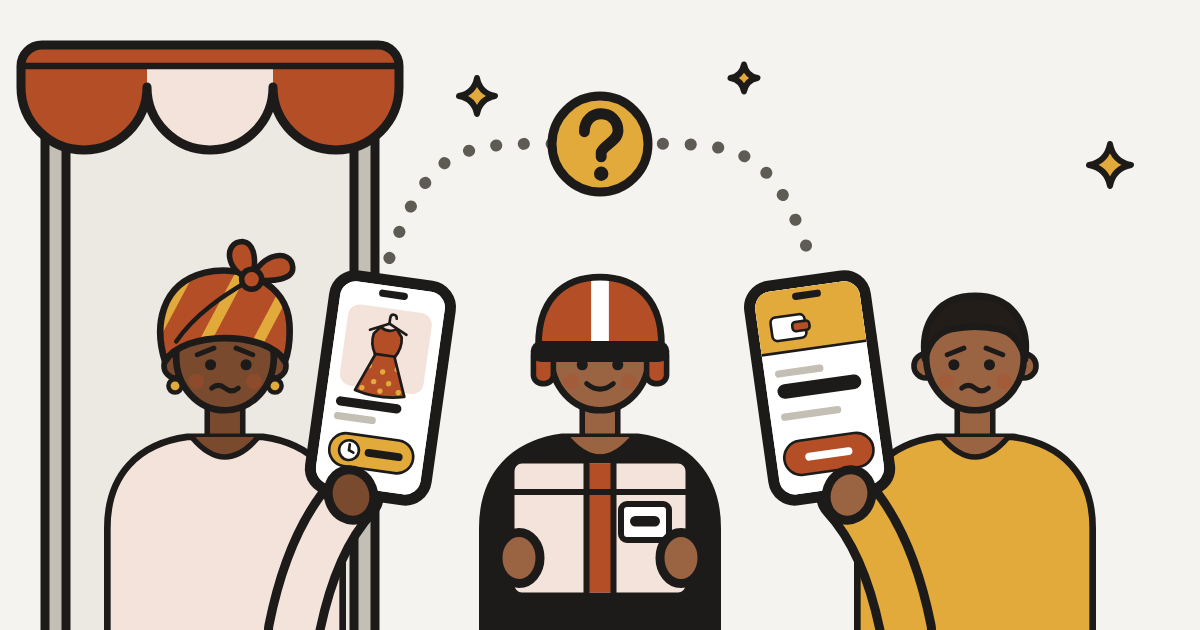
Asking for full payment first, into your personal MoMo number, saves you wasted delivery runs, but it asks a buyer who doesn’t know you to do the two things Ghana’s Cyber Security Authority tells buyers to avoid: paying before delivery, and paying into a wallet that isn’t a business account. Pay on delivery protects the buyer and leaves you with the rider’s fee, the refusals and the risk of a fake alert at the door. For most orders the answer sits in between: a deposit on custom work, the rider’s fee first on everyday items, a call before dispatch, and payment through a checkout instead of a personal number.
Both sides are protecting themselves
In a MyJoyOnline column from October 2026, Raphael Beinamwin describes sellers who “ask for full payment upfront, especially on custom orders”, and buyers who “won’t pay until the item is in front of them”.
The buyer’s side fits in one line from a Pulse Ghana column: “Can I trust you with my money?” Online, they can’t always touch the item or visit your shop before they pay.
Both fears are reasonable, and each side’s protection is the other side’s risk.
What pay on delivery costs the seller
Cash on delivery is still Ghana’s preferred way to pay for online orders, according to UNCTAD’s 2023 assessment as cited by SFAN. SFAN says it persists “because it moves risk to the merchant”: “Capital is tied up until delivery, there’s a wasted run on refusal, cash in riders’ hands, and reconciliation hurdles.”
A guide in the Accra Street Journal puts a central Accra delivery at GH¢15 to GH¢40, with more for hard-to-reach areas. If the buyer refuses the parcel or stops answering, you pay that fee for nothing.
If the buyer pays the rider by MoMo at the door, someone has to judge on the spot whether the money really arrived. MyJoyOnline reported in January 2026 that some businesses had stopped taking MoMo after fake payment alerts and “reversal fraud”, where “customers make payments, collect goods and later reverse the transaction”. One business owner said: “Sometimes a customer will come and buy something and then call MTN to retrieve the money.”
What paying first costs the buyer
For buyers, paying first is where the worst stories start. TechLabari says the Instagram vendors behind these frauds “usually insist on upfront mobile money payments”. One buyer paid for shoes and shipping that never arrived: “Subsequently they blocked my account on Instagram and I was unable to contact the seller to get a refund.” Instagram’s protection for buyers, the article adds, “is not offered in countries like Ghana”.
The Cyber Security Authority recorded 266 cases of online shopping fraud from January to October 2025, with losses of over GH¢600,000. It describes fake shops taking payment into MoMo wallets that “usually do not bear the names of the supposed shops”, after which “victims are blocked”. Its advice to buyers is plain: “Insist on payment after delivery and inspection of products.” In a March 2025 alert reported by Graphic Online, the CSA also told buyers to “Ensure mobile money transactions are made to official business accounts.”
This is the hard part for honest sellers. A Graphic Online reader wrote in June 2026 about a Facebook vendor who said “We do payment before delivery because we reserve stock for each customer” and offered “For trust, I can send my ID and business licence”. The reader paid by MoMo and the order never came. Your reasons for asking for payment first may be true, but buyers have heard the same words from scammers.
Four middle paths, and when each fits
Take a deposit on custom or costly orders
If you’re making something to measure, ordering stock in for one buyer or sending an expensive item, ask for part of the price first and the balance before or at delivery. SFAN recommends offering “deposit-plus-balance” and gives a useful rule: “Size the deposit at what a failed delivery costs you, not at a round percentage.”
Say a buyer orders a dress made to measure for GH¢400. A deposit that covers the fabric and the rider means a cancellation doesn’t leave you out of pocket, and the buyer isn’t trusting a stranger with the full price. Tell them in writing what happens to the deposit if they cancel, before they send it.
When it fits: custom work, pre-orders and anything you can’t easily sell to someone else.
Ask for the rider’s fee first on everyday orders
For items you can put straight back on sale, the cheapest protection is the one Beinamwin describes: “Often the two meet in the middle: the customer covers the rider’s fee first”. If the buyer changes their mind, the rider is already paid and your only loss is time.
When it fits: ready-made stock, buyers who are new to you, and buyers who ask to pay on delivery.
Call before you send the rider
A short call confirms the buyer is real, the address and landmark are right, someone will be home and the price is agreed. The Accra Street Journal guide lists a confirmation call before dispatch among its “practical fixes” for failed deliveries.
If the buyer will pay at the door by MoMo, check the money in your own wallet, on your MoMo app or menu, before the rider hands over the parcel. A text message or a screenshot on the buyer’s phone proves nothing on its own.
When it fits: every pay-on-delivery order, and any order going far.
Take payment through a checkout instead of a personal number
A buyer who will pay first but hesitates at a personal MoMo number is following the CSA’s advice. A merchant MoMo account gives them a business to pay, though SFAN says MTN’s needs a business registered with the Office of the Registrar of Companies and a tax number.
WhatsApp’s in-chat payments aren’t available in Ghana, so Arkesel suggests pasting a Paystack payment link into the chat instead, which opens a checkout page. The payment provider then confirms the money, so you aren’t judging a screenshot.
When it fits: buyers who are ready to pay now but don’t know you yet.
Post your rule before buyers ask
Whatever you choose, put it in your bio, catalogue or status: what you take upfront, for which items, what the rider costs and what happens if someone cancels. A buyer can then decide before messaging, and you stop negotiating it in every chat.
How MeKiosk handles this
MeKiosk is opening soon in Accra with 30 founding kiosks. Buyers pay when they order, so it sits on the pay-first side. It doesn’t hold the buyer’s money until delivery: the seller’s share goes to their own MoMo wallet the next working day, and weekend sales arrive on Monday.
The buyer picks what they want from the seller’s kiosk link, gives their name and number, and approves a MoMo prompt on their own phone: MTN MoMo, Telecel Cash or AirtelTigo Money. There’s no app and no account. If the prompt doesn’t come, they can pay on Paystack’s own page instead. They pay Paystack’s Mobile Money fee, 1.95%, on top of the price, and see it before paying.
An order turns Paid only when Paystack confirms the money, never from a screenshot or a text, and the seller gets an alert with the buyer’s name and the order code. Items are held for 15 minutes while the buyer pays, so nothing sells twice.
To protect buyers, a seller must check their Ghana Card with a selfie before taking payments, and the MoMo wallet they’re paid into must be in their own name. On their order page, a buyer can “Report a problem” within 30 days of paying. MeKiosk asks the seller to deliver or send proof within 48 hours, the buyer then has 48 hours to answer, and a person at MeKiosk decides. If the order wasn’t delivered, the buyer is refunded in full: the seller sends the money back by MoMo within 48 hours, or MeKiosk refunds them.
MeKiosk takes 1% of each paid order (VAT included), and founding kiosks pay no MeKiosk fee for their first 3 months.
If you’d like one of the founding kiosks, join the waitlist.
Sources
- The E-commerce revolution Ghana built for itself · MyJoyOnline, 27 Oct 2026
- You Saw It on TikTok, Now You're Paying on WhatsApp: What Ghanaian Businesses Get Wrong Online · Pulse Ghana, 16 Sep 2026
- How to Build the Future of B2C eCommerce in Ghana · Stars From All Nations (SFAN), 31 Aug 2026
- Courier Services in Accra and Ghana: Comparing Delivery Companies, Prices and Services · Accra Street Journal, 1 Nov 2026
- Some businesses reject Mobile Money payments as MoMo fraud cases rise · MyJoyOnline, 14 Jan 2026
- Ghanaian Instagram Shoppers Keep Falling Victim to Fraud · TechLabari, 12 May 2025
- Online shopping scam – Black Friday deals · Cyber Security Authority, 28 Nov 2025
- Cyber fraud surges to GH₵4.4million in first quarter of 2025 · Graphic Online, 1 Apr 2025
- Scammers on the loose on social media · Graphic Online, 15 Jun 2026
- How to Sell on WhatsApp Business in Ghana: Catalog, Cart and Payment Follow-Up · Arkesel, 31 May 2026